Manufactured Home Ducts: What's Under the Floor
Manufactured homes often run supply ducts through the floor, with a crossover duct in multi-section homes. How that layout works and what to check.
Manufactured homes are a big part of the housing around Clermont and FL, and their heating and cooling systems are often laid out differently from a typical site-built house. If you live in one, knowing where your ducts are and how they connect makes it easier to spot problems and decide what kind of help you need.
How the layout usually works
In many manufactured homes, the supply ducts run through the floor cavity, under the living space, rather than through the attic. The air handler or furnace pushes air into a main trunk duct, and the trunk feeds floor registers along the length of the home. ENERGY STAR requirements for manufactured homes, for example, address ducts in floor cavities and call for them to be enclosed by floor insulation.
Multi-section homes, such as double-wides, add another piece: a crossover duct. Because each section is built separately, a duct runs under the home to connect the system on one side to the ducts in the other section. That crossover sits in the space beneath the home.
Return air in many manufactured homes works differently too. Some homes rely on a central return near the air handler rather than returns in each room. Your home's layout may vary, so check your owner's documentation if you have it.
Why floor registers collect debris
Floor registers face up, so things fall into them: crumbs, pet hair, small toys, sand from shoes and dust from sweeping. Over time, that material settles in the duct below the register and in the trunk.
A few easy habits help:
- Lift and clean the register covers every so often, and vacuum the first section of duct you can reach.
- Don't sweep toward registers.
- Keep rugs and furniture off them so air can flow.
- Look for objects that may have fallen in, especially in kids' rooms.
The crossover duct deserves a look
The crossover duct is in an unconditioned space under the home, where it can be affected by animals, moisture or physical damage. ENERGY STAR requirements for multi-section homes call for the crossover to be installed with seams and joints tightly sealed against leakage and the ducts not resting on the ground, and for crossover ducts in unconditioned space to be insulated.
If you can safely see under the home, or have someone check it for you, look for:
- A crossover duct that's lying on the ground, sagging or crushed
- Tears in the outer jacket or insulation
- Connections that have pulled apart at either end
- Signs of animals or nesting nearby
- Water or standing moisture under the home
Any of these are jobs for an HVAC contractor or a contractor familiar with manufactured homes. Repairing, replacing or reconnecting a crossover duct isn't part of a duct cleaning. If an air handler or furnace has issues, that's HVAC work as well.
When cleaning makes sense
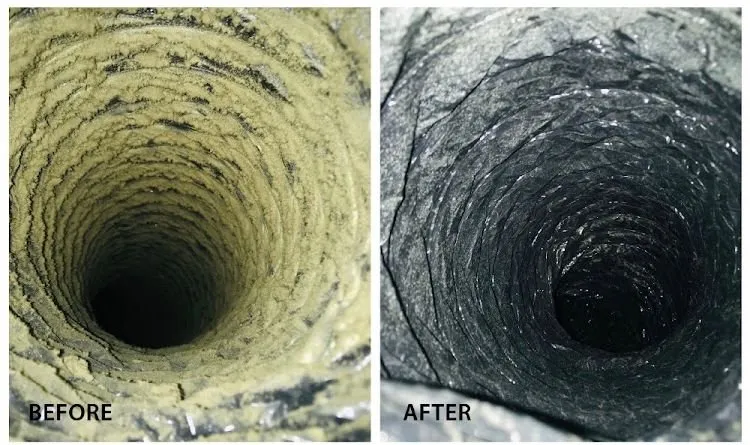
The EPA lists situations where duct cleaning should be considered, including ducts clogged with excessive dust and debris, particles released into the home from supply registers and ducts infested with vermin such as rodents or insects. If you've had a pest problem under the home, take care of the pests first. Otherwise the ducts may be contaminated again.
Signs worth paying attention to in a manufactured home:
- Dust or debris blowing out of floor registers
- Heavy buildup or objects visible when you lift a register
- Debris from recent flooring work or other renovations
- Evidence of rodents in or near the ductwork
The EPA also says that if insulated duct material gets wet or moldy, it cannot be effectively cleaned and should be removed and replaced. If you see what looks like mold, have a qualified professional assess it.
What we clean and what it costs
Our air duct cleaning covers the supply and return ducts and the registers. We use rotating brushes to loosen buildup and a HEPA-filtered vacuum to remove it. It's $199 for up to 10 vents, plus $29 for each additional vent. Count each floor register and return grille as one vent when you request an estimate, and let us know it's a manufactured home so we can plan the visit.
For a few runs that need extra attention, like one with debris packed in under a kitchen register, deep duct cleaning is $59.99 per vent.
If we see a disconnected or damaged section, including a crossover problem we can identify from the register side, we'll point it out so you can have it repaired.
We also serve communities around Clermont; see our service areas.
If your floor registers have been blowing dust, American Air Duct Cleaning Clermont can help. Our full prices are on the pricing page.
Sources
- Should You Have the Air Ducts in Your Home Cleaned?, U.S. EPA, last updated February 19, 2026
- Clothes Dryers, ENERGY STAR, accessed October 22, 2026
- ENERGY STAR Manufactured Homes National Program Requirements, Version 2, ENERGY STAR, accessed October 22, 2026